On 11 June 2026 the Science Based Targets initiative released Version 2.0 of its Corporate Net-Zero Standard, its first big update since 2021. If your company has targets, is thinking about setting them or is already reporting under AASB S2, this affects you. For Australian companies, one of the most important changes is that the requirements will now depend partly on company size and emissions profile. SBTi V2.0 also introduces stronger expectations around transition planning, Scope 3 emissions, independent assurance and ongoing reporting.
The question for businesses is therefore not simply, “Do we have an SBTi target?” It is also, “Where are we in the SBTi journey, and what will V2.0 require from us next?”
SBTi V2.0 Category A and Category B requirements in Australia
V2.0 introduces Category A and Category B companies, with Category A subject to additional requirements. Australia is currently classified by the World Bank as a high-income economy, making the high-income-country thresholds particularly relevant to Australian businesses. The criteria used to determine whether a company falls into Category A or Category B are outlined below:
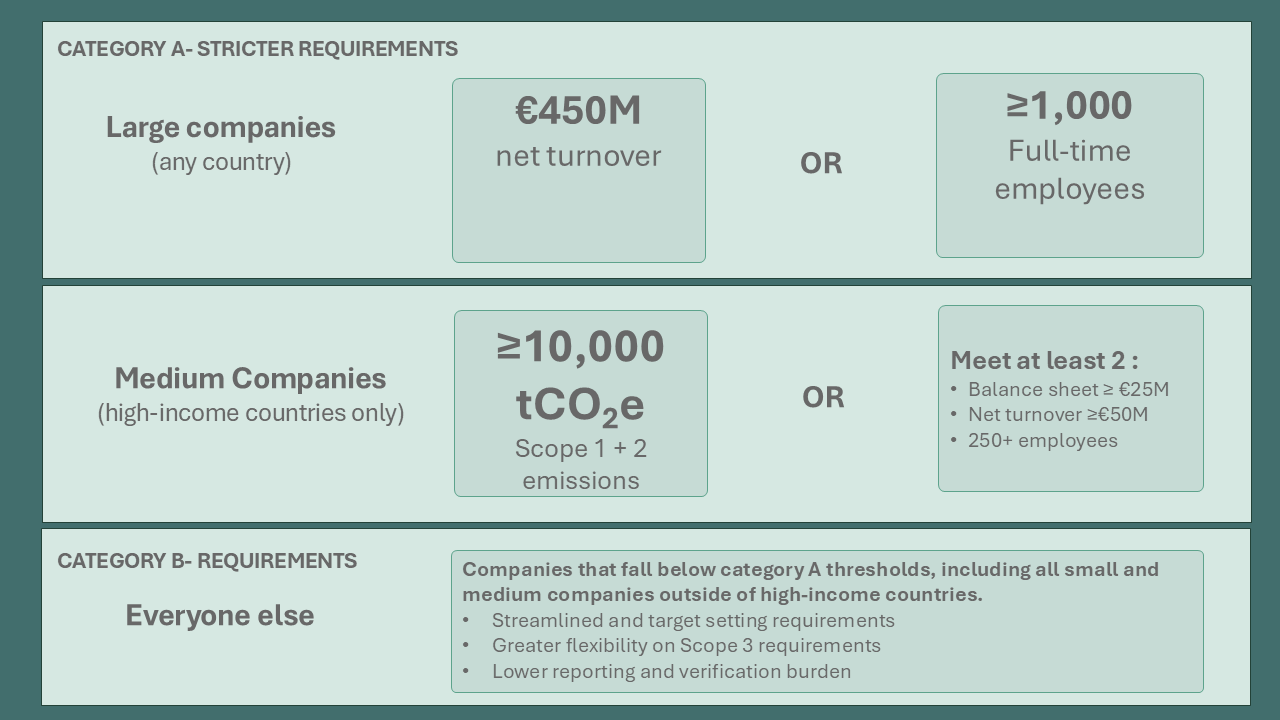
Companies that do not meet the Category A criteria are classified as Category B. This distinction matters. For example, Category A companies must obtain independent third-party assurance of their target base-year GHG inventory and associated metrics, while assurance is encouraged rather than required for Category B companies.
Important Considerations:
- Company’s category is confirmed at registration, reconfirmed at Target Validation, and applies for the full five-year cycle.
- Thresholds use the average of the two most recent financial years, on group-consolidated figures.
- Geography is determined by the jurisdiction of incorporation of the ultimate parent, classified using World Bank income categories.
- Companies not reporting in euros convert at the Reuters rate on the date of financial-statement publication.
What does your company need to do under SBTi V2.0?
1. If you have not yet set science-based targets
Start by determining whether your organisation falls into Category A or B and whether an SBTi sector standard applies.Companies will need a comprehensive GHG inventory covering Scopes 1, 2 and 3, based on recent and representative emissions data. All companies must also develop a transition plan, while Category A companies must publish their transition plan within 15 months of completing Target Validation. For Category A businesses, the base-year inventory will also require at least limited independent assurance before validation.
2. If you have made an SBTi commitment but do not yet have validated targets
Timing becomes important.V2.0 validations open on 1 February 2027. V1.3.1 remains available until 31 January 2028, with V2.0 becoming mandatory for new submissions from 1 February 2028. Existing V1.3.1 targets remain valid for their full target cycle. For companies with an existing commitment, the practical route will depend on the commitment deadline. During the transition period from February 2027 to January 2028, some companies will be able to choose between V1.3.1 and V2. This creates a useful planning window for Australian companies to assess whether submitting under the existing standard or preparing directly for V2.0 is the better approach.
3. If you already have validated SBTi targets
There is no requirement to immediately replace a valid V1.3.1 target simply because V2.0 has been published.Instead, companies should understand when their next review or target cycle is due, reassess their Category A or B status and begin preparing for the additional V2.0 requirements that will apply at revalidation. Companies with 2030 targets are specifically encouraged to begin developing their next 2030–2035 targets under V2.0 from 2028, providing sufficient time for implementation planning. For many Australian organisations, this means the period before 2030 should be used to strengthen emissions data, Scope 3 visibility and transition planning rather than waiting until the existing target reaches its end date.
4. If you are operating under V2.0
Validation is no longer the end of the process. V2.0 introduces a continuous cycle of target setting, implementation, annual reporting and end-of-cycle assessment. Companies must track and report progress against validated targets every year. At the end of the target cycle, Category A companies must have the information supporting their progress assessment independently assured. The framework therefore places greater emphasis on the quality and consistency of the carbon data supporting targets over time, rather than focusing only on the initial target submission.
What does SBTi V2.0 mean for Scope 3 emissions?
For many Australian organisations, some of the biggest practical challenges are likely to sit outside their direct operations.Under V2.0, Category A companies must set Scope 3 targets, with target coverage focusing on Scope 3 categories that individually account for 5% or more of total Scope 3 emissions. Category B companies are strongly encouraged to set Scope 3 targets.This places greater importance on understanding emissions associated with purchased goods and services, transport, capital goods, energy, waste and other value-chain activities.
How does SBTi V2.0 relate to AASB S2?
SBTi V2.0 and AASB S2 serve different purposes, but Australian companies working across both frameworks may see practical overlap in areas such as GHG emissions measurement, Scope 3 data, climate targets and transition planning.For organisations already developing emissions data and governance processes to support mandatory climate-related financial disclosures, considering how that information can also support science-based target setting may help reduce duplication and improve consistency across climate reporting and target management.
How Achilles can help Australian companies prepare for SBTi V2.0
Achilles can support organisations at different stages of the SBTi journey, from establishing a credible emissions baseline through to ongoing measurement, reduction and reporting. Through Achilles Carbon Reduce, powered by Toitū, organisations can measure Scope 1, 2 and 3 emissions using the GHG Protocol and ISO 14064-1 frameworks, develop carbon reduction plans and independently verify their GHG inventories. Achilles also supports organisations seeking to build the data and evidence needed for SBTi and other climate disclosure requirements.
For companies preparing for V2.0, this can help to:
- establish and verify a robust Scope 1, 2 and 3 GHG inventory
- strengthen the quality of base-year emissions data
- understand and manage material Scope 3 emissions
- develop measurable carbon reduction actions and transition plans
- maintain verified emissions information as targets move through their five-year cycles
- prepare the evidence required for reporting, assurance and future target validation.
The practical starting point will differ depending on whether a company is setting targets for the first time, working towards validation, or approaching the end of an existing target cycle. The common requirement across each stage is increasingly clear: credible carbon data needs to support both the target and the progress made towards it.
For Australian companies, reviewing SBTi status, company classification and emissions data now can make the transition to V2.0 considerably more manageable.
Talk to our team about preparing for SBTi V2.0.