Corporate Net-Zero Standard V2.0 Timeline
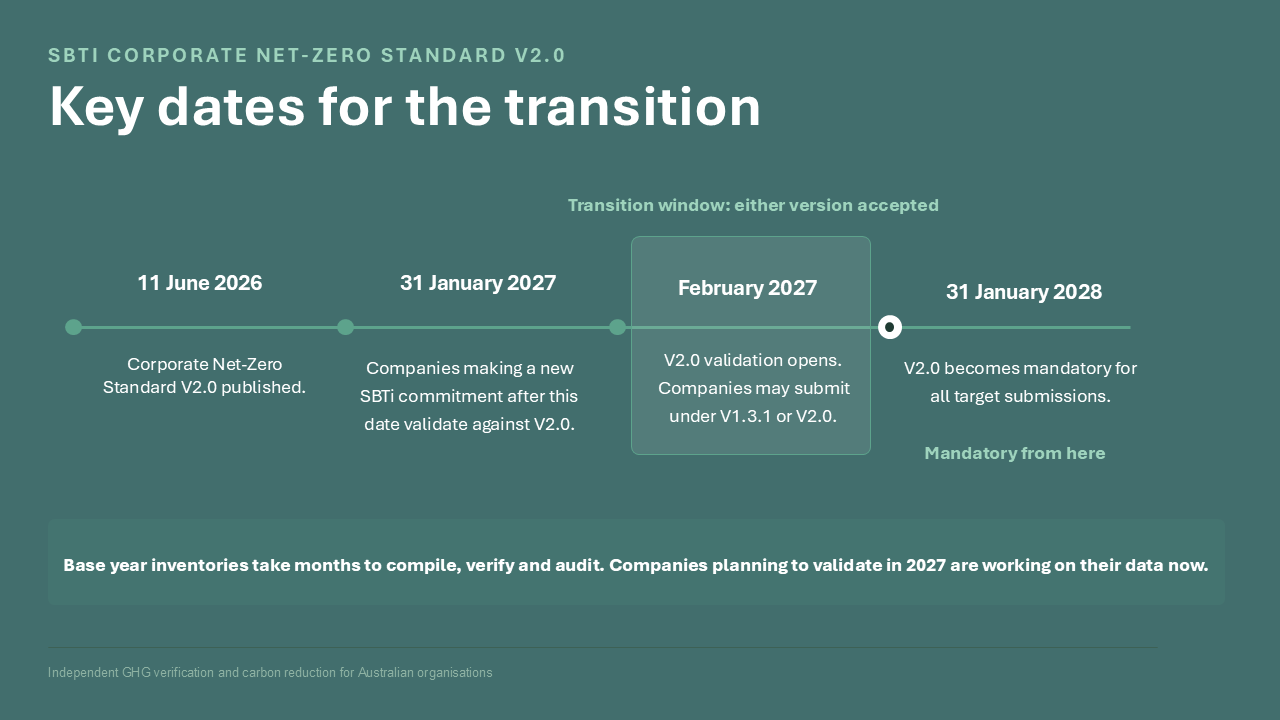
The SBTi V2.0 transition timeline for Australian companies, from publication in June 2026 to mandatory target submissions in February 2028.
The SBTi has published Version 2.0 of its Corporate Net-Zero Standard, the most significant revision since the Standard first appeared. Target validation moves to a five year cycle, larger companies face new governance, disclosure and assurance expectations, and independent verification of your base year emissions inventory moves from good practice to a requirement.
Achilles helps Australian organisations build an assurance-ready greenhouse gas inventory, prepare for target submission or renewal, and turn climate commitments into measurable emissions reduction.

Unrivalled carbon credentials



SBTi V2.0 readiness starts here
Measure your emissions once and put that verified data to work everywhere. One audited inventory supports your SBTi targets and your AASB S2 disclosures.
Understand what Version 2.0 asks of your organisation, where your current targets sit against it, and what your next validation cycle will require. Achilles advisers work with Australian companies at every stage of the journey.
Measure and verify Scope 1, 2 and 3 emissions under ISO 14064-1 and the GHG Protocol. Independent ISO 14066 auditors verify your inventory, giving you a base year you can put in front of the SBTi, your assurance provider and your board.
Scope 3 is where most Australian corporates carry the majority of their footprint and the least reliable data. Achilles collects and verifies supplier emissions data at scale, so value chain reporting is built on verified numbers.
The SBTi V2.0 transition timeline for Australian companies, from publication in June 2026 to mandatory target submissions in February 2028.
When does the SBTi Corporate Net-Zero Standard V2.0 take effect?
V2.0 was published on 11 June 2026. It becomes available for target validation from 1 February 2027. Version 1.3.1 remains open for submissions until 31 January 2028, and from 1 February 2028 Version 2.0 is mandatory for all new target submissions.
Does V2.0 require third party assurance of emissions data?
Assurance of base year data is among the requirements that apply to Category A companies and is optional for Category B companies. In practice, a verified inventory prepared and audited to recognised standards becomes the foundation of a credible submission.
What is the difference between Category A and Category B?
Category A comprises large companies in all countries and medium sized companies in high income countries. Category B comprises small companies in all countries and medium sized companies in lower income countries. Most large and mid-market Australian corporates fall into Category A.
How does this relate to AASB S2 mandatory climate reporting?
They are separate obligations that draw on the same emissions data. A verified inventory prepared to ISO 14064-1 supports both your AASB S2 climate statements and your SBTi target validation.
Do I need to start now if my targets are not due for review?
Building a complete emissions inventory, improving Scope 3 data and completing independent verification can take time, particularly for organisations with complex operations and supply chains. Starting early gives your teams time to identify data gaps, clarify organisational boundaries, engage suppliers and address assurance findings before submission.