The Science Based Targets initiative (SBTi) published Version 2.0 of its Corporate Net-Zero Standard on 11 June 2026. It is the first major revision since 2021, and it changes how targets are set, validated and reported. For Indian companies, one detail matters more than any other: your company category, and therefore how much the standard asks of you, is decided partly by where your ultimate parent is incorporated.
This is a short guide to what V2.0 changes, how Indian companies are classified, the dates that matter, how it connects with the rules you already report against, and what you need at each stage of your SBTi journey.
What changed in V2.0
V2.0 pulls the near-term and long-term journey into a single standard, replacing the earlier near-term criteria and CNZS V1.3.1. A few shifts stand out:
- Two company categories, A and B, replace the single set of rules applied to everyone.
- Validation moves from a one-off event to a continuous five-year cycle, with annual reporting throughout.
- The full greenhouse gas inventory must now cover all scopes and gases, with no exclusions permitted. Under V1.3.1 companies could exclude up to 5%.
- Scope 1 and Scope 2 targets must be set separately, each covering 100% of emissions.
- Scope 3 moves to a significance threshold: you must set targets for every Scope 3 category that individually accounts for 5 percent or more of total Scope 3.
- Direct cuts come first. The standard prioritises real reductions across Scopes 1, 2 and 3, with carbon removals and high-integrity contributions positioned as a complement to decarbonisation, never a substitute.
How SBTi V2.0 classifies companies in India
The table below shows how companies are classified under SBTi V2.0:
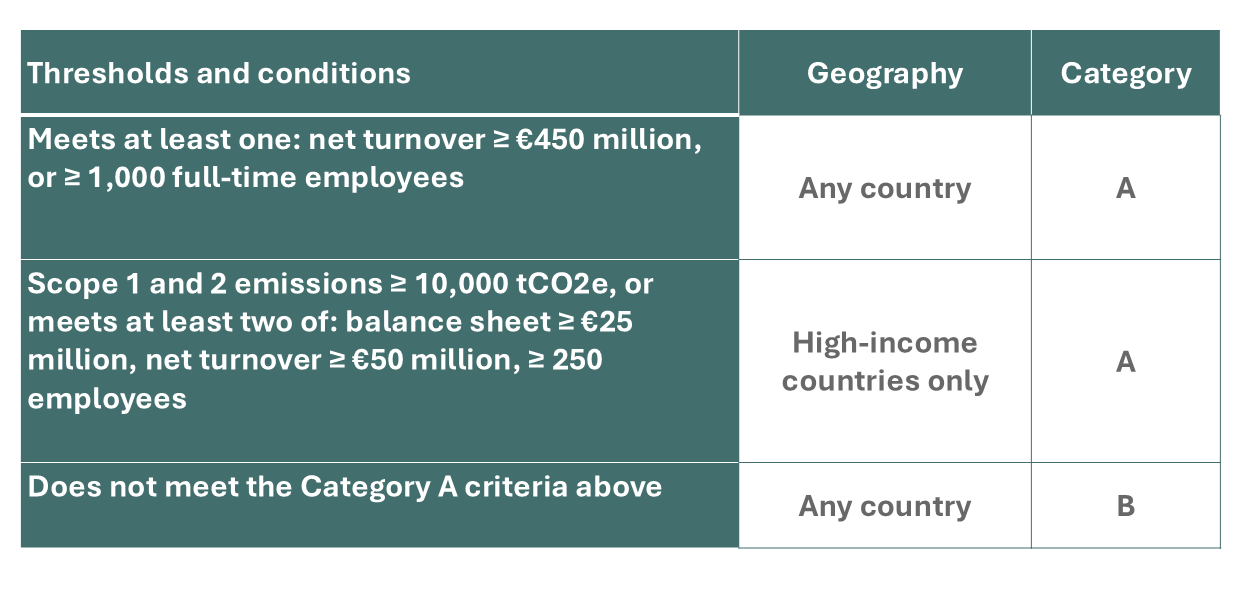
SBTi also applies additional thresholds to medium-sized companies whose ultimate parent is incorporated in a high-income country. India is currently classified by the World Bank as a lower-middle-income economy, so those additional thresholds do not currently apply to an Indian-headquartered group.
A few things to keep in mind:
- Thresholds are assessed using group-consolidated figures, averaged over the two most recent financial years and converted into euros.
- Your category is confirmed at registration, reconfirmed at Target Validation and applies for the full five-year target cycle.
- The World Bank updates its income classifications annually, so it is worth confirming the classification of the country where your ultimate parent company is incorporated when you register.
All companies must set separate near-term Scope 1 and Scope 2 targets. Category A companies must also set Scope 3 targets, while Category B companies are strongly encouraged to do so. Category A companies must obtain at least limited independent assurance of specified target base-year information and data supporting the end-of-cycle progress assessment. They must also publish a transition plan within 15 months of Target Validation. All companies must develop a transition plan, but publication is encouraged rather than mandatory for Category B.
The timeline Indian companies should plan around
The transition dates below apply to all companies, wherever they are based. Confirm your own deadlines against SBTi’s current resources, as administrative dates can be updated.
Key SBTi V2.0 dates
- 11 June 2026: Corporate Net-Zero Standard V2.0 published
- 1 October 2026: V2.0 validation resources scheduled for publication
- 1 February 2027: V2.0 validations open
- 31 January 2028: V1.3.1 validations close
- 1 February 2028: V2.0 becomes mandatory for new submissions
Why SBTi V2.0 matters for Indian companies
V2.0 does not sit on its own. It increasingly lines up with the compliance pressures Indian companies already face. Many larger Indian companies already reporting under SEBI’s BRSR framework may also meet the Category A thresholds, although SBTi classification must be assessed separately against the V2.0 criteria. Exporters in carbon-intensive sectors such as steel, aluminium and cement are managing exposure to the EU’s Carbon Border Adjustment Mechanism (CBAM) while a domestic compliance carbon market is taking shape under India’s Carbon Credit Trading Scheme (CCTS).
A validated science-based target can provide a credible, internationally recognised framework for these wider decarbonisation efforts and signal to global buyers and investors that an Indian supplier has a structured approach to emissions reduction. It can also reduce duplication by allowing a consistent GHG inventory and verified supplier data to support SBTi target setting, BRSR and BRSR Core disclosures and, where relevant, CBAM reporting.
One area to plan for early is ongoing emissions responsibility. From 2035, Category A companies must take responsibility for a share of their ongoing emissions, starting at a minimum of 1% and increasing over time towards their net-zero target year, including a growing share of durable carbon removals. That may seem some way off, but high-integrity removal supply is limited, making it worth factoring into longer-term planning now rather than waiting until the deadline.
What you need at each stage
If you are setting targets for the first time
Register with SBTi and determine whether you are Category A or B. Check whether any SBTi sector standards apply to your business. Build a full Scope 1, 2 and 3 inventory with no exclusions, using the location-based approach for Scope 2. Assign board-level accountability and begin a transition plan. If you are Category A, engage a third-party assurance provider for your base-year data. You can submit under V1.3.1 until it closes, or under V2.0 once validations open in February 2027.
If you have an active commitment but no validated targets
Your available version depends on your commitment deadline. Commitments due before 1 February 2027 use V1.3.1. Those falling between 1 February 2027 and 31 January 2028 can use either version. After that, V2.0 applies. From 1 February 2027 the near-term and net-zero commitment types are replaced by a single unified SBTi commitment, under which you commit to submit targets for validation within 24 months.
If you already hold validated targets
Your targets stay valid for their cycle. Note when your near-term targets end, and when your mandatory five-year review is triggered, whichever comes first. New targets must be submitted no earlier than 24 months before, and no later than 12 months after, the end of your current timeframe. Before then, review your Scope 3 boundary against the 5% significance threshold, and check any energy attribute certificate contracts that renew after February 2027 against the tighter V2.0 criteria.
How Achilles can help Indian companies prepare for SBTi V2.0
Achilles can support organisations at different stages of the SBTi journey, from establishing a credible emissions baseline through to ongoing measurement, reduction and reporting. Through Achilles Carbon Reduce, powered by Toitū, organisations can measure Scope 1, 2 and 3 emissions using the GHG Protocol and ISO 14064-1 frameworks, develop carbon reduction plans and independently verify their GHG inventories. Achilles also supports organisations seeking to build the data and evidence needed for SBTi and other climate disclosure requirements.
For companies preparing for V2.0, this can help to:
- establish and verify a robust Scope 1, 2 and 3 GHG inventory
- strengthen the quality of base-year emissions data
- understand and manage material Scope 3 emissions
- develop measurable carbon reduction actions and transition plans
- maintain verified emissions information as targets move through their five-year cycles
- prepare the evidence required for reporting, assurance and future target validation.
The practical starting point will differ depending on whether a company is setting targets for the first time, working towards validation, or approaching the end of an existing target cycle. The common requirement across each stage is increasingly clear: credible carbon data needs to support both the target and the progress made towards it.
If you are working out your V2.0 category, your inventory or your Scope 3 supplier engagement, talk to our team about where to start.