Who can set targets using Version 2.0?
Version 2.0 is relevant for:
- Companies preparing to renew existing targets in 2027
- Companies planning target submissions from Q1 2027
- Companies seeking to understand future requirements
Companies planning to set, update, or renew targets in 2026 are strongly encouraged to prepare them for submission at the earliest opportunity using the Corporate Net-Zero Standard V1.3.1—the most credible and robust framework for net-zero target setting available.
Companies setting or renewing targets using the current Standard will be able to take advantage of the flexibilities of the current requirements, such as combined scope 1 and 2 targets, and at the same time benefit from many of the innovations introduced in Version 2.0.
When does the SBTi Corporate Net-Zero Standard V2.0 take effect?
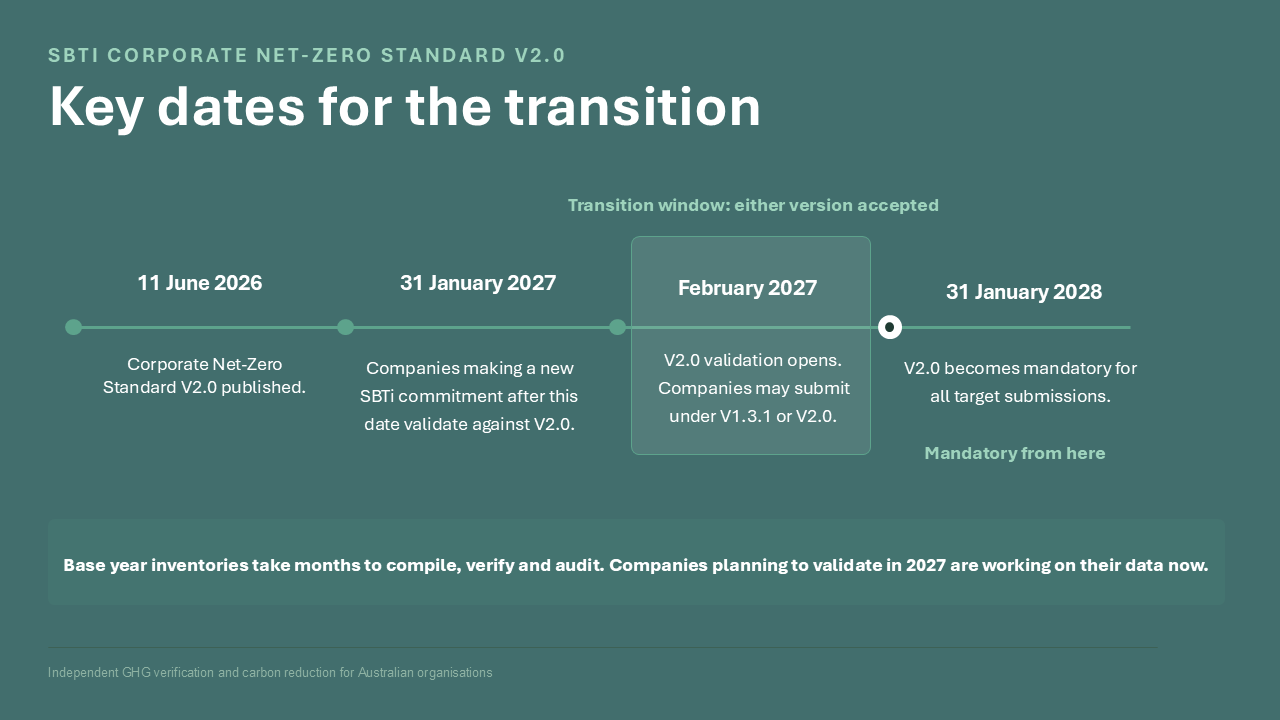
Version 2.0 was published on 11 June 2026 and becomes available for target setting from 1 February 2027. Companies can continue submitting targets under Version 1.3.1 until 31 January 2028. From 1 February 2028, all new corporate target submissions must follow Version 2.0.
Does SBTi V2.0 require independent assurance of emissions data?
Independent assurance of target base-year emissions data is required for Category A companies. It is optional, although encouraged, for Category B companies. Even where assurance is not mandatory, a verified emissions inventory can improve data quality and provide greater confidence to company leadership, investors, customers and other stakeholders.
What is the difference between Category A and Category B?
Category A generally includes large companies in all countries and medium-sized companies incorporated in high-income economies. Category B generally includes smaller companies and many medium-sized companies in lower-income economies. The category affects whether requirements such as Scope 3 target setting, base-year assurance and transition-plan disclosure are mandatory or optional.
Are Indian companies automatically classified as Category B?
No. Classification depends on the SBTi criteria, including company size, consolidated group information and the jurisdiction in which the ultimate parent company is incorporated. A large Indian company or an Indian business owned by an overseas parent may fall within Category A. Organisations should assess their individual circumstances before determining which requirements apply.
Are Scope 3 targets required under SBTi V2.0?
Scope 3 target setting is required for Category A companies and optional for Category B companies. Organisations may still choose to set Scope 3 targets where value-chain emissions are material or where customers, investors and other stakeholders expect evidence of supply-chain decarbonisation.
Is SBTi V2.0 the same as BRSR Core?
No. SBTi is a voluntary framework for setting and implementing science-based greenhouse gas reduction targets. BRSR Core forms part of India’s sustainability disclosure framework for listed entities. The frameworks have different requirements, but both can benefit from reliable emissions data, documented methodologies and effective internal controls.
Can the same emissions inventory support SBTi and BRSR Core?
A well-governed emissions inventory can provide a consistent data foundation for both. However, organisations should separately review the boundaries, metrics, methodologies and reporting requirements of each framework. Preparation for one framework should not be treated as automatic compliance with the other.
Do companies with existing SBTi targets need to take immediate action?
Companies with validated targets do not need to replace them immediately. Their existing targets generally remain valid for the applicable target period. An early review can still help organisations understand the updated Standard and improve emissions data, supplier engagement and assurance readiness before the next target cycle
What information should an organisation review first?
A readiness review should consider:
- Organisational and operational boundaries
- Base-year selection and recalculation policies
- Scope 1 and Scope 2 source data
- Scope 3 screening and category coverage
- Supplier data quality
- Emissions factors and calculation methodologies
- Governance, controls and supporting evidence
- Existing reduction plans and transition activities