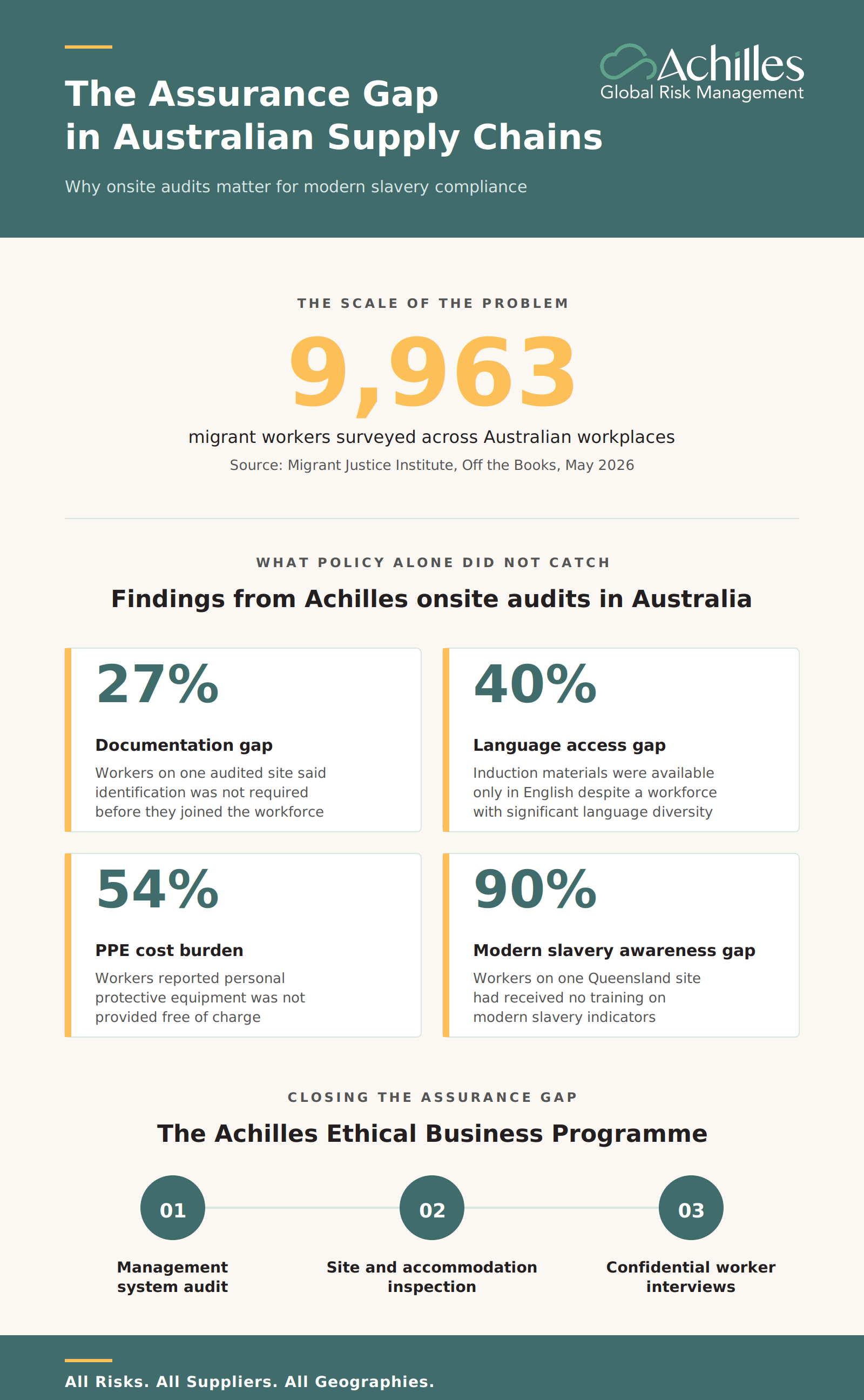
A new national survey from the Migrant Justice Institute, drawing on responses from 9,963 migrant workers, points to systemic exploitation across Australian supply chains. The findings land at a moment when Australian organisations face growing pressure to understand what is happening across their supplier networks, not only at the policy level but at the site level where people work, risks emerge and compliance is tested in practice. The report found that 83% of survey respondents had worked at night, when activity is less visible and conditions are often less safe.
For sectors such as construction, closing the assurance gap is particularly important. The sector often depends on extended contractor networks, subcontracted labour, temporary workers, specialist site services and geographically dispersed operations. A supplier may look compliant on paper while gaps in worker treatment, training, wage practices or safety controls remain hidden unless they are independently verified.
Australian organisations sourcing products, services and materials across complex supply chains are also facing greater pressure to identify, report and address modern slavery risks. With increased focus from the Australian Anti-Slavery Commissioner’s office on stronger modern slavery reporting and due diligence, organisations need assurance programmes designed to detect risks early and support meaningful supplier improvement.
The Assurance Gap Between Policy and Practice
Onsite audits conducted by Achilles in Australia point to a consistent assurance gap. Across audited sites, recurring issues emerged around worker documentation, language access, PPE provision and modern slavery awareness. These findings highlight why ethical business controls cannot rely on supplier self-declarations alone.
Findings from recent Achilles onsite audits in Australia include:
- 27% documentation gap. On one audited site, workers reported that identification was not required before they joined the workforce. Without verified right-to-work documentation, a supplier cannot demonstrate that workers are legally engaged, and the buyer inherits the resulting modern slavery exposure.
- 40% language access gap. Induction materials at the site were available only in English, despite a workforce with significant language diversity. Workers who cannot read or understand safety inductions, grievance procedures or their employment terms are not only structurally unable to exercise their rights, but are also exposed to heightened safety risk, including increased likelihood of accidents, misunderstanding critical site controls, and failure to respond appropriately in emergency situations.
- 54% PPE cost burden. Employees on one audited site reported that personal protective equipment was not provided free of charge. Charging workers for mandatory PPE is both a workplace health and safety failure and a recognised indicator of unfair labour practices.
- 90% modern slavery awareness gap. On one Queensland site, workers had received no training on modern slavery. Without awareness of exploitation indicators or reporting channels, workers cannot effectively act as the first line of defence that grievance mechanisms often rely on.
Each finding above represents a control that exists at parent company policy level but has not flowed through to the contractor, subcontractor or labour-hire operation actually performing the work.
How Achilles’ Ethical Business Programme Supports Better Assurance
The Achilles Ethical Business Programme provides a comprehensive, triangulated audit approach aligned with recognised international frameworks and standards. It helps organisations move beyond policy review and supplier declarations by testing how ethical business practices are applied in real working environments.
The programme includes three key components:
- Management system audit
This assesses a company’s policies, procedures and controls to understand whether they align with relevant ESG legislation, standards and industry expectations. - Site and accommodation inspection
Achilles auditors inspect supplier premises to evaluate environmental, safety and wellbeing protections across working and living areas. - Confidential worker interviews
Workers are given a safe and confidential space to share concerns, raise issues and provide direct insight into working conditions. This helps ensure that worker perspectives are reflected in the audit process.
Why High-Risk Sectors in Australia Need Closer Attention
The Migrant Justice Institute report also highlights sector-specific risk patterns. Among surveyed workers, construction workers were underpaid by an average of $9.37 per hour among those receiving less than their entitlement, and 66% of construction workers in the sample were underpaid to some degree.
Many organisations already have supplier codes of conduct, modern slavery statements, onboarding questionnaires and contractual clauses. These are important foundations, but they do not always confirm what is happening on the ground.
The report found that where workers had no payslip, were paid in cash or received no superannuation, approximately seven in ten were paid below the National Minimum Wage and around nine in ten were paid below their minimum legal entitlement.
This is where onsite audits create value. They help organisations move assurance beyond what is declared and test whether policies, worker protections and ethical standards are being applied in practice.
How Onsite Audits Help Close the Supply Chain Assurance Gap
Independent onsite audits help organisations understand whether workers know their rights, whether employment records are consistent, whether induction materials are accessible, whether PPE is provided appropriately and whether site practices align with legal, contractual and ethical expectations.
A well-structured audit can examine:
- Supplier documentation, licences, worker records and right-to-work controls
- Wage, payslip and employment arrangement indicators
- Health and safety practices, including PPE access and site induction
- Worker grievance mechanisms and awareness of reporting channels
- Modern slavery awareness, training and escalation processes
- Evidence of subcontracting, labour hire or informal work arrangements
- Corrective actions and evidence of supplier improvement over time
The strongest audit programmes do not stop at identifying nonconformities. They create a pathway for improvement, supported by corrective action plans, supplier engagement and follow-up verification.
Why this matters now
Australia’s regulatory environment is moving toward stronger, risk-based due diligence. The recent position paper by the Australian Anti-Slavery Commissioner’s office has called for mandatory risk-based due diligence obligations under the Modern Slavery Act. At the same time, independent research shows that worker exploitation in Australian supply chains is not isolated. It often appears in patterns that can be identified through well-designed assurance and audit programmes.
Policy assurance and supplier self-attestation remain important, but they are not enough on their own. Onsite, worker-level verification helps close the gap between organisational commitments and supplier-level practice.
Strengthen Ethical Business Assurance Across Your Supplier Network
Achilles helps organisations identify supplier risk, strengthen visibility and support continuous improvement through ethical business audits, supplier due diligence, ESG assessment and corrective action tracking.
Strengthen visibility across your supplier network. Learn how Achilles’ Ethical Business Programme can help your organisation identify risk, improve supplier performance and prevent unethical working practices across the supply chain.
Frequently asked questions
Why are onsite audits important for supply chain due diligence?
Onsite audits help organisations verify whether supplier policies are being applied in practice. They can identify gaps in worker documentation, training, safety controls, wage indicators, grievance mechanisms and modern slavery awareness.
How do onsite audits help prevent modern slavery risks?
Onsite audits reveal practical risk indicators such as poor worker records, lack of training, unsafe conditions, excessive hours, wage concerns, language barriers and weak reporting mechanisms. These findings help organisations take corrective action earlier.
Why are construction and energy supply chains considered higher risk?
Construction and energy supply chains often depend on multiple tiers of contractors, labour hire, outsourced site services and geographically dispersed operations. This can make worker conditions harder to monitor without independent verification.
How does Achilles help organisations manage ethical business risks?
Achilles supports organisations through supplier due diligence, risk assessment, onsite audits, ESG and modern slavery assurance, corrective action tracking and supplier improvement programmes. This helps organisations build stronger visibility and control across their supply chains.