
A clean, accurate, and continuously maintained supplier database delivers significant annual financial and operational benefits—often far exceeding its maintenance cost.
Across procurement and data management benchmarks, organizations typically achieve:
- 1–5%+ savings on total supplier spend
- 20–30% improvements in operational efficiency
- Significant reductions in payment leakage, compliance exposure, and working capital inefficiencies
For mid-to-large enterprises, this translates into:
$1M to $30M+ in annual value creation depending on scale and supplier spend
Supplier Information Management is not an administrative function. It is a core financial and risk infrastructure capability that underpins procurement performance, compliance, and supplier risk control.
Platforms such as Achilles enable organisations to maintain verified, structured, and continuously updated supplier data across complex global supply networks.
1. Direct Cost Savings Through Spend Optimization (1–5%)
High-quality supplier data enables organisations to eliminate inefficiencies hidden in fragmented supplier records.
Key value drivers:
- Removal of duplicate or redundant suppliers
- Consolidation of spend with strategic vendors
- Improved negotiation leverage through spend visibility
- Reduction in off-contract or “maverick” purchasing
Typical impact:
For a company with $100M annual supplier spend:
- Even 2% savings = $2M per year
These savings are driven by:
- Better visibility into total spend
- Volume consolidation opportunities
- Stronger commercial negotiation positions
2. Process Efficiency Gains (20–30%)
Clean supplier data significantly reduces manual effort across procurement and finance operations.
Key impacted processes:
- Accounts payable processing
- Purchase order creation and matching
- Supplier onboarding and maintenance
- Vendor communication and dispute resolution
Typical impact:
- AP processing cost reductions of $5–$15 per invoice
- For 100,000 invoices annually → $500K–$1.5M savings
Additional benefits include:
- Faster invoice-to-payment cycles
- Fewer manual corrections and exceptions
- Reduced operational bottlenecks
3. Duplicate Payments and Error Reduction
Poor supplier data quality is a leading cause of financial leakage.
Common issues include:
- Duplicate vendor records
- Duplicate invoice submissions
- Incorrect or misrouted payments
Typical impact:
Eliminating these errors reduces leakage by:
- 0.1%–0.5% of total supplier spend
Even at the lower end, this represents material financial recovery at scale.
4. Working Capital Optimization
Accurate supplier data improves financial control and cash flow management.
Key improvements:
- Correct payment terms enforcement
- Reduced invoice disputes
- Improved forecasting accuracy
Typical impact:
- Even a 1–2 day improvement in Days Payable Outstanding (DPO) can release millions in working capital for large enterprises
This benefit is often under-recognized but highly material in enterprise finance planning.
5. Risk Reduction and Compliance Protection
High-quality supplier data strengthens risk and compliance controls across the organisation.
Key capabilities enabled:
- Accurate tax and banking information
- Reliable sanctions and compliance screening
- ESG and regulatory reporting integrity
Value outcomes:
- Reduced fraud and payment diversion risk
- Lower probability of regulatory penalties
- Stronger audit readiness and traceability
In many cases:
Preventing a single fraud or compliance failure can save hundreds of thousands to millions annually.
6. Better Decision-Making and Strategic Value
Clean supplier data enables more informed procurement and sourcing decisions.
Key improvements:
- Reliable spend analytics
- Supplier performance tracking
- ESG, diversity, and regulatory reporting accuracy
Strategic impact:
- Improved sourcing decisions
- Identification of cost reduction opportunities
- Stronger, more resilient supplier relationships
Summary of Annual Benefits
The financial and operational value of effective supplier information management comes from multiple areas across the organization. While some benefits are immediately measurable, such as spend optimization and process efficiency, others reduce hidden costs associated with errors, compliance gaps, and poor decision-making. The table below summarizes the typical annual impact organizations can achieve by establishing accurate, complete, and continuously maintained supplier data.
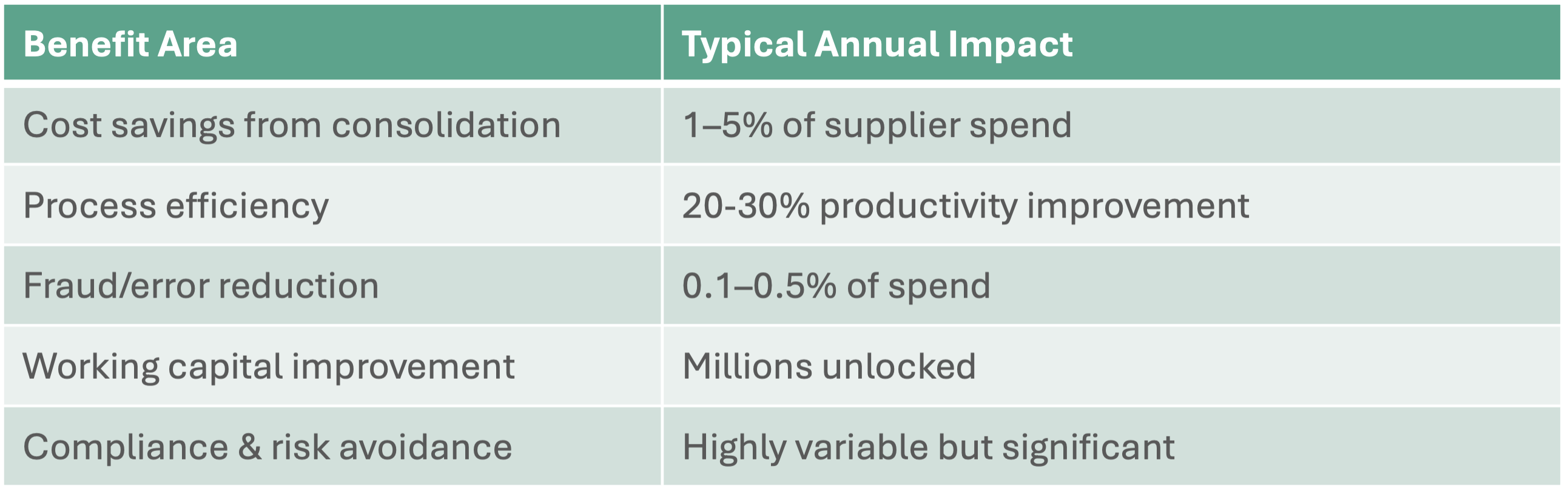
The cumulative impact can be significant. For organizations managing large supplier ecosystems, even small improvements in data quality can translate into millions of dollars in annual value through better procurement decisions, reduced administrative effort, improved cash management, and stronger risk control.
Overall Estimated Value
For mid-to-large enterprises:
- $50M spend → $1M–$3M annual benefit
- $500M spend → $10M–$30M+ annual benefit
Bottom Line
Supplier Information Management is not an administrative or data hygiene exercise. It is a high-ROI enterprise capability that directly enables:
- Cost reduction
- Operational efficiency
- Financial control
- Risk mitigation
- Better strategic decision-making