
Executive Summary
Supplier risk doesn’t stand still. Companies change ownership, face legal action, appear on sanctions lists, attract negative media attention, or become associated with financial crime long after they have been approved as suppliers.
Yet many organizations continue to rely on point-in-time due diligence conducted only during onboarding or periodic reviews, creating months of unmanaged exposure between assessments.
For a typical enterprise managing approximately 2,500 suppliers, continuous supplier risk monitoring can deliver more than $500,000 in annual business value through improved operational efficiency, reduced regulatory exposure, stronger procurement decisions, and earlier identification of emerging supplier risks.
By continuously monitoring sanctions, watchlists, criminal records, adverse media, politically exposed persons (PEPs), and other external risk indicators, organizations can replace reactive supplier management with proactive risk intelligence.
Platforms such as Achilles help organizations continuously monitor supplier risk across global supply chains, enabling faster decisions, stronger compliance, and greater operational resilience.
Download the full white paper here.
1. Point-in-Time Supplier Checks Leave Significant Risk Gaps
Traditional supplier due diligence provides a snapshot of risk at a single moment in time. However, supplier risk evolves continuously.
Organizations routinely experience supplier changes including:
- New ownership structures
- Financial crime investigations
- Regulatory enforcement actions
- International sanctions
- Criminal convictions
- Adverse media coverage
- Geographic or geopolitical developments
For organizations managing approximately 2,500 suppliers, it is reasonable to expect 5–10% of suppliers to experience meaningful changes each year.
That means procurement teams may have between 125 and 250 suppliers whose risk profile changes between scheduled reviews, creating substantial blind spots.
Continuous monitoring closes this visibility gap by identifying changes as they occur, rather than months later.
2. Automation Significantly Reduces Manual Effort
Managing supplier risk across thousands of organizations is increasingly impractical using manual processes.
Risk teams often spend significant time:
- Collecting supplier information
- Reviewing multiple databases
- Investigating alerts
- Validating supplier status
- Resolving false positives
For an organization managing 2,500 suppliers, this can consume approximately 1,875 hours annually.
Automated supplier intelligence can reduce this workload by approximately 75%, returning around 1,400 hours to higher-value activities.
At a fully burdened analyst cost of approximately $65 per hour, this equates to:
Annual operational savings of approximately $91,000.
3. Continuous Monitoring Strengthens Regulatory Compliance
Regulatory expectations surrounding third-party risk continue to increase.
Organizations must demonstrate appropriate due diligence around sanctions, anti-money laundering (AML), anti-bribery regulations, and other compliance obligations.
Continuous monitoring enables organizations to identify suppliers appearing on:
- Global sanctions lists
- Terrorist watchlists
- Politically exposed person (PEP) databases
- Criminal records
- Regulatory enforcement notices
Earlier identification reduces the likelihood of regulatory breaches while improving audit readiness and governance.
Even avoiding a single sanctions-related compliance issue can prevent substantial financial penalties and reputational damage.
4. Early Warning Protects Business Continuity
Supplier issues rarely emerge without warning.
Negative media coverage, criminal investigations, regulatory actions, or financial misconduct often become visible long before operational disruption occurs.
Continuous monitoring provides procurement teams with early warning signals, allowing them to:
- Investigate concerns
- Engage suppliers proactively
- Develop contingency plans
- Source alternatives before disruption occurs
For organizations where a significant supplier disruption costs approximately $1.5 million, reducing the frequency of major incidents can generate substantial annual business value.
5. Better Intelligence Improves Procurement Decisions
Supplier intelligence is not only about avoiding risk.
It also improves commercial decision-making.
Access to continuously updated supplier profiles enables procurement teams to:
- Identify suppliers with increasing risk
- Strengthen contract negotiations
- Adjust service levels and commercial terms
- Prioritize supplier development
- Consolidate spend where appropriate
Better information leads to better purchasing decisions throughout the supplier lifecycle.
6. Consolidating Risk Intelligence Reduces Cost and Complexity
Many organizations use separate tools for:
- Sanctions screening
- Adverse media monitoring
- Criminal record searches
- News alerts
- Supplier risk databases
Managing multiple point solutions increases cost while creating fragmented visibility.
A unified supplier risk intelligence platform simplifies operations, reduces duplicate software spend, and provides a single source of supplier risk information.
7. Translating Continuous Monitoring Into Annual Business Value
The value of continuous supplier risk monitoring comes from multiple sources rather than a single cost saving.
For an organization managing approximately 2,500 suppliers, typical annual benefits include:
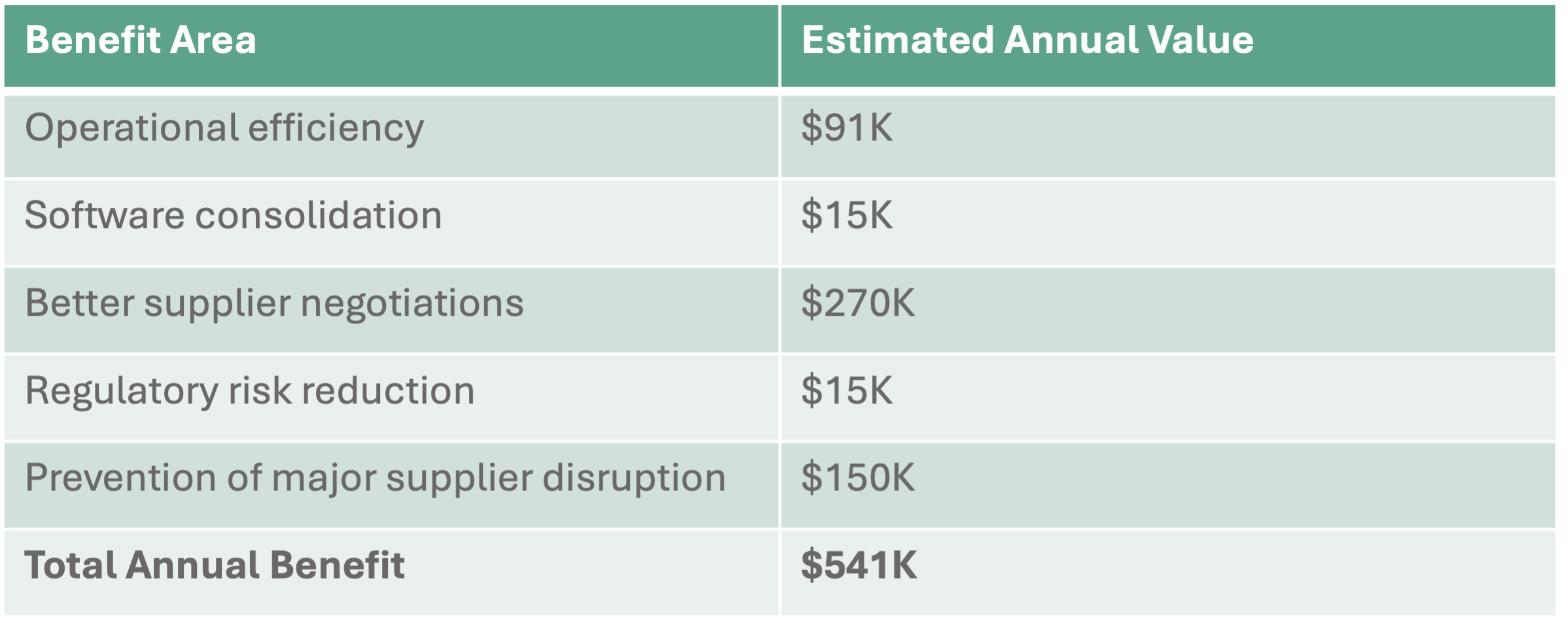
These figures represent conservative estimates and exclude secondary benefits such as improved customer confidence, stronger governance, and reduced reputational risk.
8. The Cost of Continuous Monitoring vs. The Cost of Inaction
Compared with the financial impact of supplier disruption or regulatory enforcement, continuous monitoring represents a relatively modest investment.
For a typical enterprise:
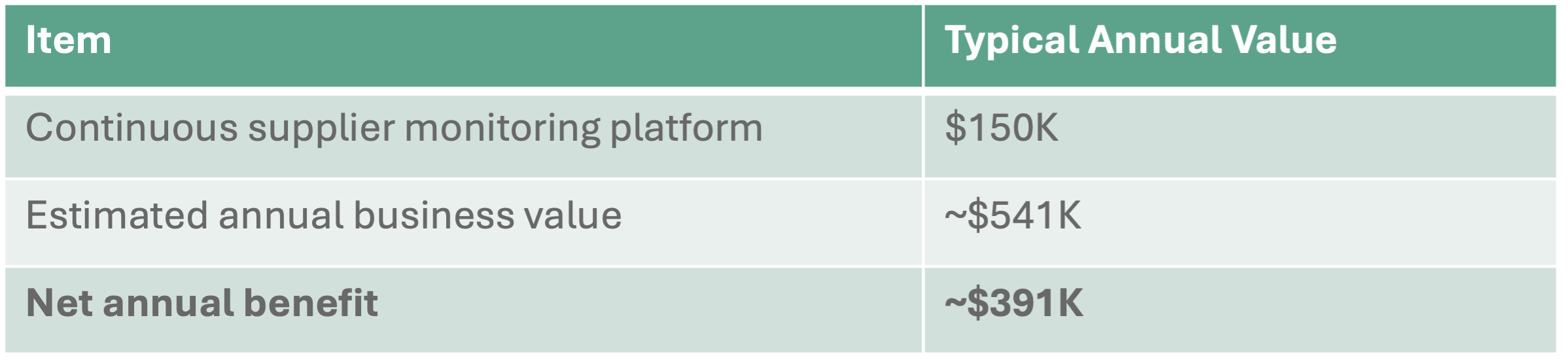
This equates to an estimated 260% first-year ROI with a payback period of less than four months.
Conclusion: Supplier Risk Intelligence is a Competitive Advantage
Supplier risk is constantly changing.
Organizations that rely solely on periodic supplier reviews inevitably develop blind spots that increase operational, financial, and regulatory exposure.
Continuous supplier risk intelligence provides ongoing visibility into changing supplier risk, allowing procurement and risk teams to act before issues become business disruptions.
As supplier ecosystems become larger, more global, and more interconnected, continuous monitoring is rapidly becoming a core capability for organizations seeking to improve resilience, strengthen governance, and make more informed supplier decisions.