Executive Summary
Financial instability remains one of the leading causes of supply chain disruption. As economic conditions become more volatile, organizations need greater confidence that the suppliers they depend on can continue to deliver throughout the life of a contract.
For a typical mid-size to large enterprise, assessing supplier financial stability before engagement—and monitoring financial health throughout the supplier relationship—can deliver:
$400,000 to $3 million in annual avoided losses, with ROI commonly in the 6×–20× range relative to the cost of financial due diligence and ongoing monitoring.
For organizations operating complex or business-critical supply chains including manufacturing, healthcare, technology, energy, and infrastructure, the potential value is often substantially higher.
Supplier financial due diligence is no longer simply an onboarding activity. It is a continuous risk management capability that helps organizations identify deteriorating suppliers before disruption occurs.
Platforms such as Achilles enable organizations to combine supplier qualification with ongoing financial monitoring, providing earlier visibility into emerging supplier risk.
Download the full white paper here.
1. Supplier Financial Failure Is a Growing Business Risk
Financial distress continues to be one of the most common drivers of supplier disruption.
Research shows:
- Approximately 25% of organizations have experienced supply chain disruption directly caused by supplier financial failure.
- Corporate bankruptcy filings remain significantly above long-term historical averages.
- Financial viability is now considered a core supplier risk alongside cybersecurity, geopolitical instability, and regulatory compliance.
The implication is straightforward.
Organizations working with hundreds of suppliers should expect some suppliers to experience financial distress. The question is not whether it will happen—but whether warning signs are identified early enough to respond.
2. Financial Distress Creates Significant Operational and Financial Consequences
When financially weak suppliers fail, the impact extends well beyond replacing a vendor.
Organizations commonly experience:
- Emergency sourcing at premium prices
- Production delays or operational downtime
- Missed customer commitments and contractual penalties
- Loss of deposits, tooling, or prepaid inventory
- Increased logistics and expediting costs
Research consistently shows that financially constrained suppliers recover more slowly from disruption and are significantly more likely to fail altogether.
Supply chain disruptions can consume 6–10% of annual revenue, while major events frequently erase an entire quarter’s profit for affected organizations.
3. Financial Risk Can Be Identified Before It Becomes Operational Risk
Supplier financial deterioration rarely occurs without warning.
Financial due diligence identifies indicators such as:
- Declining liquidity
- Increasing debt levels
- Late payment behavior
- Credit rating deterioration
- Legal actions, liens, or going-concern warnings
These indicators allow organizations to:
- Avoid engaging high-risk suppliers
- Introduce mitigation measures such as dual sourcing
- Adjust commercial terms
- Increase monitoring where exposure is greatest
The earlier these signals are identified, the more options organizations have to reduce disruption.
4. Translating Financial Risk Into Annual Business Value
A conservative mid-market model illustrates the potential financial impact.
Assumptions
- 150 active suppliers
- 10–15% exhibit elevated financial risk
- One material supplier failure every 4–6 years
- Average financial impact per failure: $1.5M–$2.0M
Expected Annual Exposure Without Financial Screening
Using these assumptions:
$1.75M ÷ 5 years ≈ $350,000 annual expected loss
This represents the average annual financial exposure before mitigation measures are applied.
Impact of Financial Due Diligence
Financial screening and ongoing monitoring typically reduce exposure by 40–60% through:
- Identifying financially unstable suppliers before contract award
- Detecting deteriorating suppliers earlier
- Supporting contingency planning and supplier diversification
- Allowing commercial terms to be adjusted according to risk
Using a conservative 50% reduction:
$350,000 × 50% ≈ $175,000 in annual avoided losses
For organizations with larger supplier ecosystems or more business-critical suppliers, the avoided losses can be significantly higher.
5. The True Cost of Supplier Failure Is Often Much Higher
The direct cost of supplier failure is only part of the picture.
Research shows:
- Every $1 of lost sales at a disrupted supplier can generate approximately $2.40 in downstream losses across connected organizations.
- Secondary costs—including overtime, expedited logistics, alternative sourcing, and contractual penalties—often multiply the original financial impact by 2.5×–4×.
- More than 60% of global organizations report measurable declines in financial performance following significant supplier disruptions.
These cascading effects explain why financial due diligence consistently delivers value beyond the immediate cost of avoiding supplier failure.
6. Expected Annual Benefits by Organization Size
While every organization has a different supplier footprint, the financial case becomes stronger as supplier populations and operational complexity increase.
Typical annual benefit ranges include:
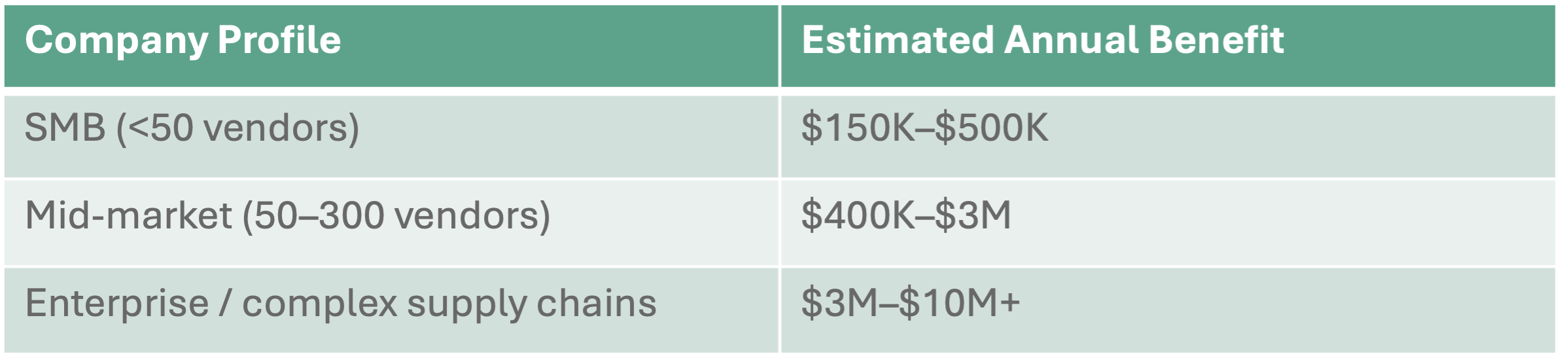
Even organizations with relatively modest supplier populations can realize substantial returns by preventing a single financially driven disruption.
7. Cost of Financial Screening vs. Cost of Supplier Failure
Compared with the financial impact of supplier disruption, the cost of financial due diligence is relatively small:
- Financial health screening: $50–$200 per supplier
- Annual screening program (200 suppliers): $10K–$40K
- One significant supplier failure: $1M–$5M+
For many organizations, avoiding a single major supplier failure can fund 10–25 years of financial due diligence activity.
Conclusion: Financial Due Diligence Is a Business Continuity Control
Supplier financial due diligence is one of the highest-return investments organizations can make because:
- Financial failures are relatively common
- Their impact is significant and often cascading
- Early warning indicators are well understood
- Screening and monitoring are inexpensive relative to potential losses
As supply chains become more interconnected and economic conditions remain uncertain, leading organizations are moving beyond one-time supplier assessments toward continuous financial monitoring that provides earlier visibility into emerging supplier risk.