
Who are our suppliers?
- Which suppliers matter most?
- What risks do they present?
- How confident are we in the information we hold about them?
These questions can be surprisingly difficult to answer, even for organizations with established procurement systems and processes. Supplier information is often spread across multiple systems, business units, and regions. Records may be duplicated, inconsistent, out of date, or missing altogether. And even where organizations do have reliable supplier records, they can often lack the detailed information and verified evidence needed to assess suppliers properly.
As procurement takes on greater responsibility for managing supplier risk, resilience, compliance, and business continuity, these gaps become increasingly important. Supplier intelligence and assurance help address them.
What is supplier intelligence and assurance?
Supplier intelligence and assurance bring together supplier information, risk intelligence, verification, due diligence, and ongoing monitoring to help organizations understand their suppliers and make informed decisions throughout the supplier relationship. This includes establishing who suppliers are, assessing whether they meet business requirements, identifying potential risks, and determining where further investigation or independent assurance is needed. It also means keeping that information current as supplier circumstances, external conditions, and business requirements change.
The gap between supplier data and supplier intelligence
For many organizations, the first challenge is establishing an accurate picture of their supplier base. Supplier information may be held across multiple ERP systems, procurement platforms, spreadsheets, and business units. The same supplier can appear under different names or legal entities, records may be incomplete, and information collected in one part of the business may not be available elsewhere.
Even where confidence in existing supplier data is high, the information held rarely provides the depth needed to understand supplier financial health, operational capability, risk exposure, compliance, or whether a supplier meets specific business requirements. There is also the question of reliability. Information may be self-reported, out of date, or unsupported by sufficient evidence. For higher-risk or more critical suppliers, additional verification, due diligence, or independent assurance may be required.
These are connected but different challenges: establishing who suppliers are, gathering the information needed to assess them, and having confidence that the information is accurate and remains current.
Where supplier intelligence and assurance fit in the procurement technology stack
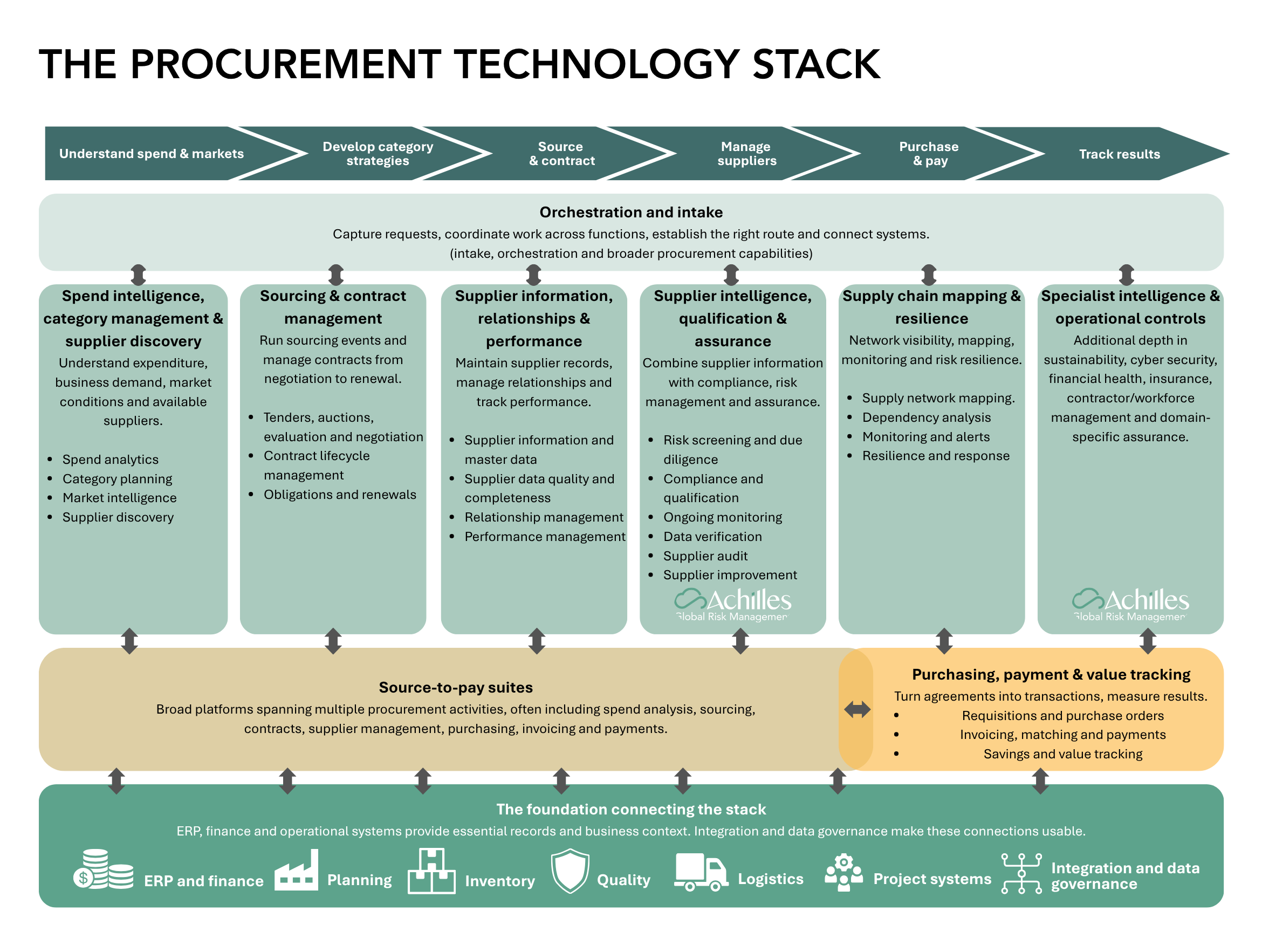
The procurement technology stack covers a broad range of activities, from spend analysis and category management to sourcing, contracting, supplier management, purchasing, and payment. Some platforms support much of this lifecycle. Others specialize in particular activities, risk domains, or operational requirements.
- Supplier information management maintains supplier records, identities, and supporting documentation.
- Sourcing and procurement platforms manage commercial processes, supplier selection, approvals, and transactions.
- Supplier relationship and performance management tracks delivery, quality, service, and improvement activity.
- Supply chain mapping and resilience provides visibility into supply networks, upstream dependencies, and potential disruptions.
- Supplier intelligence and assurance adds detailed supplier information, external risk indicators, verification, due diligence, and independent assessment.
These are not mutually exclusive categories. Procurement platforms may include some risk assessment and supplier management capabilities, while specialist providers like Achilles offer additional intelligence, verification, domain expertise, and depth of assurance.
The important consideration is how these capabilities work together. Successful supplier intelligence informs sourcing, qualification, approvals, ongoing supplier management, and decisions about where further action is required.
What are the core components of supplier intelligence and assurance?
Supplier visibility and information
A reliable view of the supplier base starts with accurate supplier identities, company information, relevant documentation, and an understanding of the relationships between organizations, sites, and legal entities. Existing supplier records provide a starting point. Additional information may need to be collected, checked, and maintained to support qualification, compliance, and ongoing supplier management.
Risk intelligence
Supplier risk intelligence combines information about the supplier with external conditions that could affect its ability to meet requirements or continue operating. Depending on the organization and supplier population, this can include:
- Financial risk
- Cybersecurity risk
- Environmental, social, and governance (ESG) risk
- Sanctions and watchlist exposure
- Adverse media
- Geopolitical and country risk
- Operational and health and safety risk
- Insurance risk
Continuous screening helps identify emerging issues across the supplier base, allowing procurement teams to focus attention where it is most needed.
Verification and validation
Not all supplier information provides the same level of confidence. A completed questionnaire, a reviewed document, and independently verified evidence serve different purposes. The level of checking required depends on the information involved, the supplier’s role, and the consequences of getting a decision wrong. Verification and validation help establish whether supplier information is accurate, complete, and supported by appropriate evidence.
Due diligence and independent assurance
Not every supplier requires the same level of scrutiny. The appropriate level of due diligence depends on factors such as financial or operational risk, supplier criticality, business dependency, regulatory requirements, and the potential consequences of failure.
For some suppliers, risk screening and documentary evidence may be sufficient. Others require detailed assessments, further investigation, or independent audits that examine actual practices and controls. A risk-based approach allows organizations to direct more intensive assurance toward the suppliers and activities that justify it.
Ongoing monitoring and action
Supplier circumstances change throughout the relationship. Financial conditions deteriorate, ownership changes, certifications expire, new risks emerge, and the importance of a supplier to the business can increase. Ongoing monitoring helps identify these changes, but identifying an issue is only part of the process.
Organizations also need to determine whether the change is relevant, whether further assessment is required, who needs to respond, and what corrective action should follow. Connecting monitoring with supplier requirements and business criticality helps teams prioritize their time and resources.
How Achilles helps
Achilles combines supplier intelligence, qualification, and assurance to help procurement teams establish a clearer, more reliable, and more current view of their suppliers.
Our approach brings together three important sources of information:
The supplier: Detailed supplier information, qualifications, certifications, financial health, insurance, compliance evidence, and findings from assessments and audits.
The world around them: External intelligence covering financial, cyber, geopolitical, sanctions, adverse media, sustainability, and other risk indicators.
Their role in your business: Supplier criticality, category, dependency, operating requirements, and the level of assurance needed for the work they perform.
Achilles delivers this through a combination of capabilities and services:
- Existing supplier intelligence: Drawing on the Achilles supplier network and information already collected and reviewed, helping customers start with more information rather than collecting everything from scratch.
- Supplier qualification and data collection: Gathering detailed information and evidence, assessing suppliers against customer requirements, and addressing gaps in supplier information.
- Risk screening and monitoring: Identifying risk indicators across the supplier base and monitoring changes that may require attention.
- Verification and independent assurance: Reviewing supporting evidence, conducting detailed assessments and independent audits, and helping customers address identified findings.
- Risk-based prioritization: Combining supplier intelligence with business context to help customers determine where further investigation, assurance, or action is justified.
Achilles works alongside existing procurement and enterprise systems, providing supplier information, risk intelligence, and assurance that can support decisions throughout the supplier lifecycle.
With more than 35 years of experience in supplier assurance and a global network of supplier information and expertise, Achilles helps organizations improve the quality of the information they hold, understand risk across their supplier base, and apply deeper assurance where it matters most.
For procurement teams, that means less time gathering and checking information, greater visibility into changing supplier risks, and better evidence to support decisions about resilience, safety, compliance, and business continuity.