Supply chain due diligence, non financial reporting, and compliance are becoming more complex, but the underlying process is still fragmented
Supply chain due diligence has evolved from a periodic procurement activity into a continuous requirement shaped by regulation, increasing disruption, and growing stakeholder scrutiny. Organisations are now expected to maintain accurate, auditable, and up-to-date supplier information across areas such as compliance, sustainability, and risk.
Supplier data is still commonly collected in organisational silos, repeated across multiple buyers, and stored in inconsistent formats. Each organisation effectively builds its own version of supplier information — duplicating effort across both buyers and suppliers.
This leads to three persistent challenges:
- High sector-wide cost of supplier onboarding and assessment
- Inconsistent supplier data across systems and teams
- Limited visibility across the global supply chain
At the same time, organisations are operating in an environment of increasing disruption, from geopolitical instability and trade volatility to cyber risk, ESG scrutiny, and supply shortages, all of which place greater pressure on the quality and speed of supplier decision-making.
As expectations increase, fragmented approaches to supplier due diligence become harder to sustain.
The structural problem: fragmented supply chain due diligence
Despite advances in procurement technology, many organisations still rely on disconnected processes to manage supplier information.
Common issues include:
- Supplier questionnaires repeated for each buyer relationship
- Lack of standardisation in assessment criteria
- Heavy reliance on spreadsheets and manual processes
- Static, point-in-time supplier data that quickly becomes outdated
- Difficulty consolidating data for reporting
- Limited ability to benchmark suppliers and make defensible procurement decisions
While often treated as operational inefficiencies, these issues reflect a deeper structural problem: an absence of a shared system for supplier intelligence. As a result, there is a high level of duplication, increasing costs for both buyers and suppliers and limited quality insight available for decision-making.
How a network model improves supply chain compliance and efficiency
A network-based approach to supply chain due diligence addresses this fragmentation by enabling organisations to share a common framework for supplier assessment and validation.
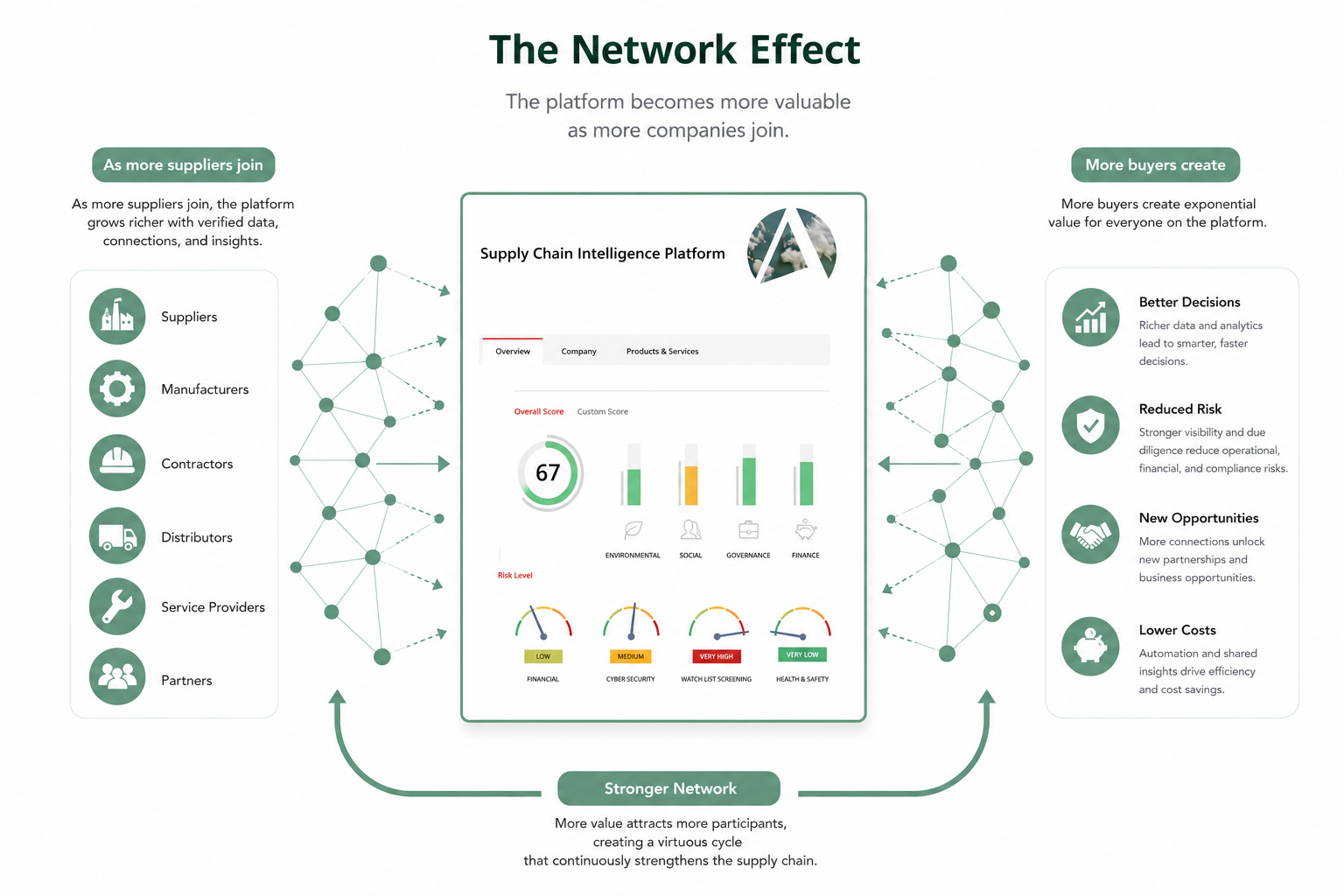
Instead of each buyer independently collecting supplier data, suppliers complete a single structured assessment that can be reused across multiple organisations within the network. This creates a more efficient and consistent system for managing supplier information.
Key benefits of a network approach:
1. Standardised supplier assessment data
A shared framework ensures supplier information is collected and evaluated consistently across organisations and industries.
2. Reduced duplication across the supply chain
Suppliers complete one assessment rather than multiple buyer-specific questionnaires, reducing administrative burden.
3. Continuous supplier monitoring and updates
Supplier data is maintained over time rather than relying on static onboarding checks.
4. Improved comparability of supplier performance
Organisations can benchmark suppliers more effectively using consistent data.
Benefits for procurement, risk, and sustainability teams
For buying organisations, a network model reduces both operational workload and compliance risk.
Key benefits include:
- Lower supplier onboarding and due diligence costs
- Reduced manual effort in procurement and compliance teams
- Access to verified and continuously updated supplier data
- Improved audit readiness and regulatory compliance
- Better visibility of supplier risk across categories and regions
- More consistent ESG and sustainability reporting
This enables teams to shift focus from data collection to supplier risk management and decision-making.
Benefits for suppliers
Suppliers also benefit from reduced friction in meeting multiple buyer requirements. Instead of responding to repeated assessments, suppliers complete a single structured process recognised across the network.
This results in:
- Fewer duplicate questionnaires and reduced administrative workload
- Greater exposure to multiple buyers through a single profile
- Independent validation of compliance and ESG credentials
- Faster onboarding into new customer relationships
- More consistent representation of supplier capabilities
This improves efficiency while increasing market access.
Regulatory drivers: increasing pressure for better supply chain data
Regulation is a key driver accelerating the shift toward network-based supply chain due diligence. Frameworks such as the EU CSDDD and evolving national procurement and ESG disclosure requirements are increasing expectations for:
- Supply chain transparency
- Evidence-based due diligence
- Consistent sustainability reporting
- Continuous supplier monitoring
At the same time, organisations are expected to deliver this with limited additional internal resource. A network model helps address this imbalance by reducing duplication and enabling shared, validated supplier intelligence across multiple organisations.
As highlighted by the Supply Chain Intelligence Institute, Vienna, pooled due diligence systems can improve both efficiency and effectiveness by reducing duplication while strengthening compliance incentives across the system.
Real-world example: UK utilities sector
The benefits of the network model are already demonstrated in established sector collaborations.
In the UK utilities sector, more than 65 organisations have worked with Achilles for over 25 years to operate a shared supplier qualification and validation network.
This model has delivered significant efficiencies, including estimated sector-wide savings of approximately £22 million annually, alongside reduced duplication of supplier assessments and improved procurement consistency.
From fragmented processes to shared supplier intelligence
As supply chains become more complex and regulatory expectations continue to rise, organisations face increasing pressure to improve both the quality and efficiency of supplier due diligence. Traditional approaches based on fragmented, organisation-specific processes are no longer sufficient at scale.
A network-based model provides a structural alternative enabling organisations to share supplier intelligence, reduce duplication, and improve compliance outcomes without increasing operational burden. As with other network-driven systems, value increases with participation. The more connected the network, the more efficient and effective supply chain compliance becomes.