From the conversations at ProcureCon East in September to the agenda for the upcoming CIPS North America Conference, it is clear that procurement is no longer being asked simply to manage spend. It is increasingly expected to support business resilience, manage third-party risk, navigate regulatory requirements, improve sustainability performance, and help organizations respond to geopolitical and supply chain disruption.
At ProcureCon East in Boston last month, AI, automation, and procurement’s expanding responsibilities were recurring themes. Next month, the inaugural CIPS North America Conference in New York, The Architect Era: Procurement’s Global Pivot, will explore many of the same challenges, including autonomous sourcing, digital transformation, third-party cyber risk, and business value creation.
As procurement’s influence grows, so does the pressure on teams to make faster, better-informed decisions. The question is whether the information and support available to them are evolving at the same pace.
Procurement has more technology than ever. But is it enough?
The modern procurement technology landscape is more sophisticated than at any point in history. Organizations now use a wide range of tools to manage sourcing, contracts, purchasing, supplier records, spend analysis, workflow automation, and supplier relationships.
These systems play an essential role in helping procurement operate efficiently. They provide visibility into spending, suppliers, contracts, and performance, but procurement’s responsibilities are expanding. Beyond managing transactions, teams are increasingly expected to help their organizations navigate supply chain disruption, third-party cyber risk, regulatory requirements, sustainability commitments, contractor safety, and business resilience.
To fulfil that role, procurement needs more than process automation and workflow management. It needs confidence in the suppliers that underpin the business.
Do we actually know who our suppliers are?
For many organizations, establishing a reliable picture of their supplier base remains surprisingly difficult. Supplier records are often spread across ERP platforms, procurement systems, finance databases, contract repositories, and spreadsheets. The same supplier may appear under multiple legal entities, naming conventions, or business units. Information is duplicated, incomplete, or outdated.
This matters because every decision that follows depends on having an accurate foundation. An ERP system will tell you who you’re paying. A procurement platform may tell you who you’re buying from. But neither necessarily provides a complete view of supplier qualifications, insurance coverage, financial health, compliance status, operational capability, or risk exposure.
Recent Gartner research highlights this challenge. Its July 2026 report, Improve Supplier Risk Scoring in 5 Steps, discusses the limitations of disconnected and incomplete supplier data when organizations attempt to build meaningful supplier risk insights. Without a reliable supplier foundation, it becomes difficult to answer even basic questions about risk, resilience, and performance, but of course, clean supplier data is not the end goal.
From supplier records to supplier intelligence
Once organizations know who their suppliers are, they need to understand far more about them. Effective supplier decisions depend on three dimensions of intelligence:
- The supplier: Financial health, qualifications, insurance, compliance, safety, operational capability, and verified evidence.
- The world around them: Geopolitics, cyber threats, sanctions, adverse media, and other external risks.
- Their role in your business: Criticality, dependency, requirements, and the consequences of failure.
This third dimension is often the most important. As any experienced procurement professional knows, suppliers should be assessed in the context of the role they play in the organization. CIPS guidance on supplier risk assessment recognizes this, highlighting the importance of supplier criticality when determining risk and appropriate assurance requirements.
A financial warning affecting a readily replaceable supplier demands a different response from one affecting a contractor supporting critical infrastructure. The level of assurance required for a professional services provider is also very different from that needed for a contractor undertaking high-risk work.
This is where supplier intelligence becomes critical. Organizations need more than supplier records. They need the information and context required to understand which suppliers matter most, what risks they present, and where assurance efforts should be focused.
Beyond the technology stack: who does the work?
Even when organizations know what information they need, obtaining and maintaining it can become a significant operational burden. Someone has to engage suppliers, collect evidence, verify documentation, monitor expiring qualifications and insurance certificates, conduct assessments, follow up on corrective actions, and continuously review changes in risk.
For organizations managing large supplier and contractor populations, this can represent a substantial workload. AI and automation can undoubtedly improve efficiency, but they do not eliminate the work itself.
Which raises another question: who is actually responsible for doing the work?
Bridging the gap between supplier data and supplier confidence
This is where Achilles sits within the procurement ecosystem. We help organizations move beyond supplier records and develop trusted supplier intelligence through supplier engagement, information collection, verification, independent assessments, risk monitoring, and ongoing assurance.
Supported by intelligent technology, including Smart Achilles, and delivered through a global network of assurance professionals, our role is not simply to provide another platform. It is to help organizations obtain and maintain the supplier intelligence they need while reducing the administrative burden on internal teams.
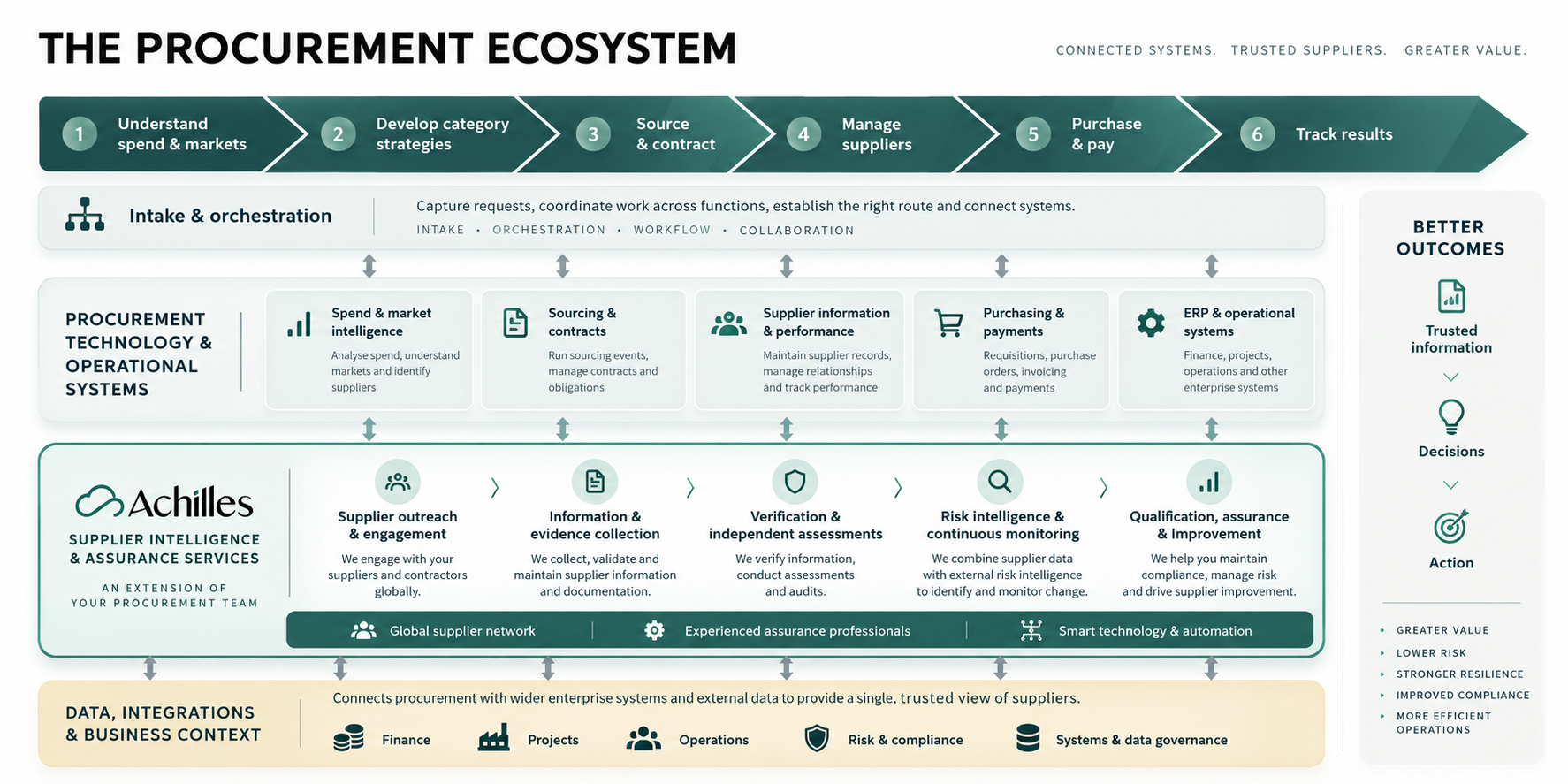
Technology, intelligence, and assurance services working together to support procurement decisions throughout the supplier relationship.
Three questions procurement needs to ask
As organizations continue investing in AI and digital transformation, three questions are worth considering:
- Do we have a reliable view of our supplier base? Can we establish a consistent picture across systems, entities, and business units?
- Do we have the intelligence and assurance needed to understand risk? And who is responsible for collecting, verifying, and maintaining that information?
- Can the right people act on that intelligence? Does it reach procurement, operations, compliance, and business leaders in a way that supports decision-making?
These questions are important because faster processes are only valuable if they lead to better outcomes.
From better information to greater influence
Today, procurement sits at the intersection of commercial performance, operational resilience, risk management, compliance, and sustainability. It is often the first function to spot emerging supplier risks, the team responsible for ensuring standards are met across the supply base, and increasingly a key contributor to business continuity and long-term resilience.
In many ways, procurement has become one of the organization’s unsung heroes. Its influence extends far beyond the purchase order, helping protect the business from disruption while enabling growth and operational performance. To deliver on that responsibility, procurement needs more than efficient processes. It needs confidence in the information behind its decisions and the ability to maintain that confidence at scale.increasingly placing on its shoulders.
Is your procurement ecosystem giving you the full picture?
Discover how Achilles combines supplier intelligence, independent assurance, and intelligent technology with the people and expertise to do much of the work for you here >
Achilles will be exhibiting at the CIPS North America Inaugural Conference in New York on November 9–10, 2026. Come and meet our team to discuss how supplier intelligence, independent assurance, and intelligent technology can help your procurement team deliver more, without adding to its workload.