For mid-size to large enterprises, performing cybersecurity screening on prospective suppliers before onboarding delivers an estimated:
$0.8M to $4.5M in annual avoided losses, with typical ROI of 6×–25× relative to the cost of vendor cyber due diligence.
In highly regulated sectors such as financial services, healthcare, and SaaS, the financial exposure is often significantly higher due to regulatory penalties, breach notification obligations, and extended incident recovery timelines.
No longer a technical assurance exercise, Cybersecurity screening is now a financial risk control embedded at the point of supplier onboarding.
Platforms such as Achilles enable organizations to standardize this process across large supplier bases, combining structured due diligence with ongoing supplier risk visibility.
1. Third-Party cyber risk is now a primary attack vector
Modern breach patterns show that supplier ecosystems have become one of the most exploited entry points for cyberattacks.
- 30–35.5% of all data breaches originate via third parties rather than internal systems
- 77% of organizations that experienced breaches in the past three years trace at least one incident back to vendors or suppliers
- Third-party breaches cost ~40% more than internal breaches, driven by legal complexity, forensic scope, and regulatory exposure
Supplier cybersecurity is now a primary breach pathway, not a peripheral risk. For organizations with large vendor ecosystems, exposure is no longer theoretical. It is structural and recurring.
2. The financial impact of a single supplier breach is severe
The cost of third-party cyber incidents is consistently higher than most organizations anticipate.
- Global average cost of a third-party data breach: ~$4.9M
- U.S. average: ~$10.2M per incident
- Supply-chain breaches typically last longer and require broader remediation than direct attacks
These costs include:
- Incident response and containment
- Regulatory fines and mandatory disclosures
- Legal settlements and litigation
- Revenue loss and customer churn
- Contractual liability to downstream customers
Unlike internal incidents, supplier-related breaches often create multi-party liability chains, amplifying financial and reputational damage.
3. Cybersecurity screening identifies risk before liability transfers
Cyber due diligence is designed to surface risk signals before a supplier gains access to systems, data, or critical processes.
Standard onboarding controls typically identify:
- Lack of multi-factor authentication (MFA)
- Weak patch management practices
- Misconfigured cloud infrastructure
- Exposed credentials or known vulnerabilities
- Insufficient access controls for vendor integrations
Structured approaches, including questionnaires, SOC 2 reviews, and external security ratings, materially improve risk detection. Without formal screening, organizations may miss up to 40% of critical vendor cyber risks, allowing vulnerable suppliers into the environment undetected.
4. Converting cyber risk into financial exposure
A conservative mid-market model illustrates the scale of exposure:
Assumptions
- 150–300 active suppliers
- 20–30% have access to sensitive systems or data
- Annual probability of a material third-party cyber incident: 15–25%
- Average incident impact: $4–6M
- Screening reduces incident likelihood by 30–50%
Expected Loss Model (Illustrative)
Without screening:
- Expected annual loss ≈ $1.0M
With screening:
- Risk reduction ≈ 30–50%
- Avoided loss ≈ $300K–$500K+ annually (conservative)
More severe scenarios, particularly in regulated sectors, push this significantly higher due to regulatory penalties and downstream liability exposure.
5. Why real-world exposure is often higher than models suggest
Cascading supplier impact
Cyber incidents rarely remain isolated. On average, each vendor breach compromises ~5 downstream organizations, multiplying indirect exposure across supply chains.
Even when not publicly disclosed, affected organizations still incur:
- Internal investigation and containment costs
- Operational disruption
- Customer reassurance and remediation activity
Regulatory amplification
Regulatory enforcement is increasingly focused on third-party controls:
- 76% of GDPR fines are linked to third-party failures
- 46% of HIPAA breaches involve vendors or business associates
- Frameworks such as DORA, NIS2, NYDFS, and SEC cyber disclosure rules significantly increase accountability for supplier risk management
The direction of regulation is consistent. Organizations are responsible for their vendors’ cyber posture, not just their own.
6. Expected benefit ranges by organization size
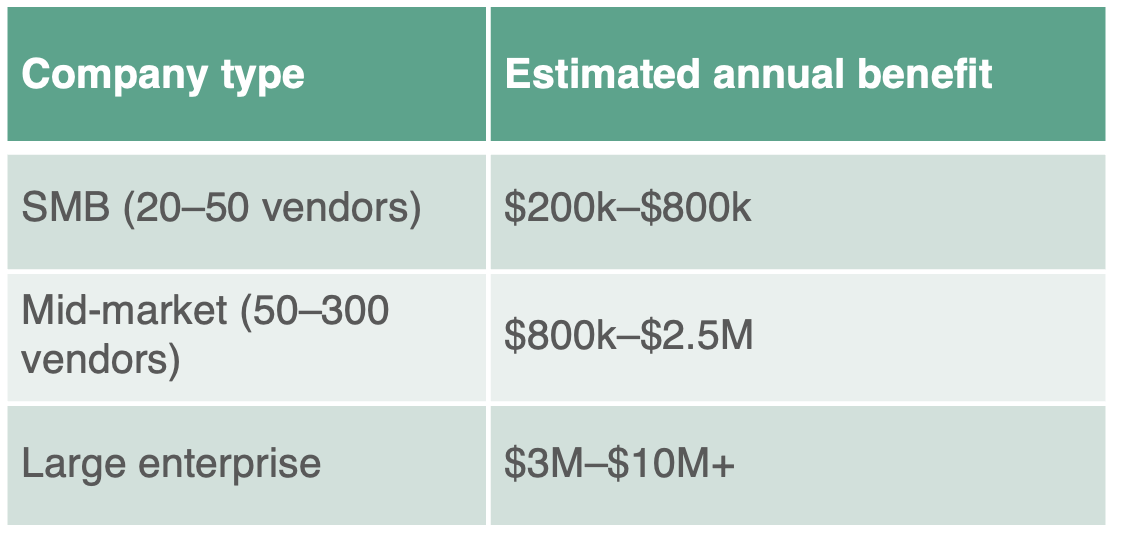
Cybersecurity screening programs typically cost $25K–$150K annually, resulting in strong positive ROI even under conservative assumptions.
Conclusion: cyber risk is now an onboarding decision problem
Cybersecurity risk in supply chains is no longer defined by perimeter defence, it is defined at the point of supplier entry.
The economics are consistent across industries:
- Third-party breaches are frequent
- Financial impact is severe
- Risk signals are detectable before onboarding
- Prevention cost is comparatively low
This combination makes cybersecurity screening one of the highest-return risk controls available to modern enterprises.
For organizations operating complex supplier ecosystems, structured platforms such as Achilles enable cyber due diligence to move from a fragmented compliance activity to a repeatable, decision-grade control embedded in supplier selection and governance.